The True Costs of Disconnected Business Systems
Siloed Systems: Beyond Subscription Costs
Ideally, technology should streamline workflows and enhance productivity in any environment. Yet many growing businesses unknowingly reach a point where their software begins creating more work than it removes.
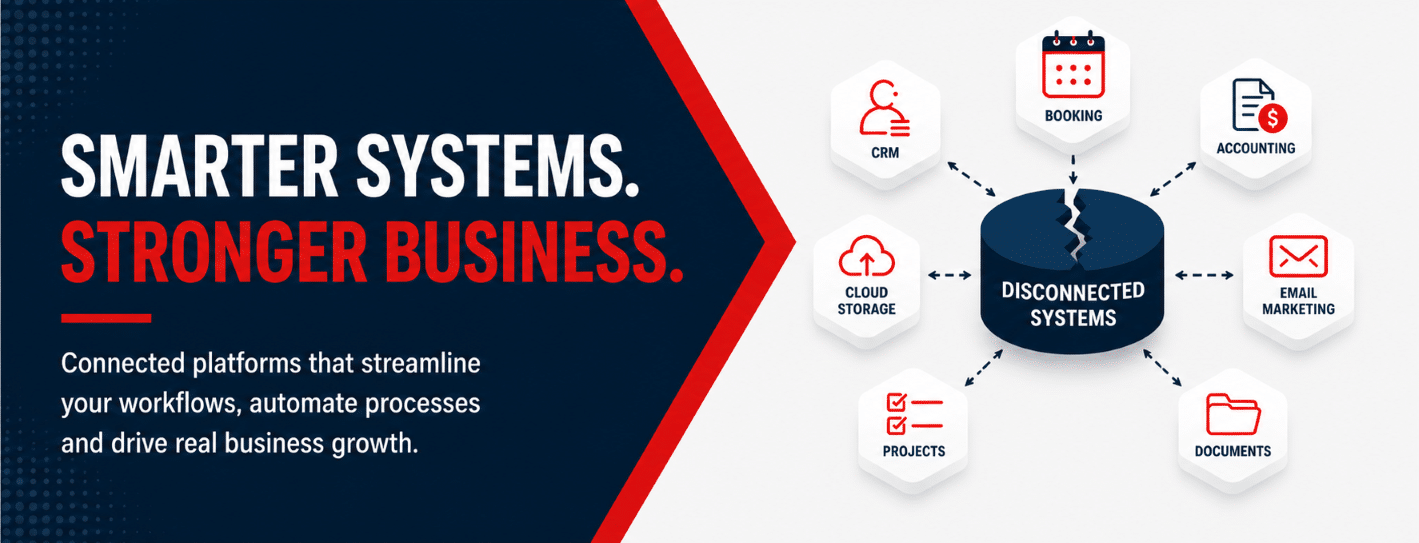
What starts as a handful of helpful applications with manageable monthly or yearly subscriptions, gradually evolves into a collection of disconnected systems, each solving one specific problem while inadvertently introducing another.
⇒ A CRM for enquiries.
⇒ A booking system for appointments.
⇒ Accounting software for invoicing.
⇒ Email marketing for customer communication.
⇒ Project management for internal tasks.
Individually, each platform delivers value. Collectively, they often create a disconnected business that revolves around maintaining software rather than serving customers.
Often referred to as siloed systems, tech stack fragmentation or isolated applications, disconnected business systems quietly increase operational overhead through duplicated administration, manual workarounds and fragmented data.
The Hidden Cost: Operational Friction
Unlike software subscription costs, these inefficiencies rarely appear as a single line item on a Profit & Loss statement. Instead, they hide within everyday business activities, consuming staff time, slowing decision-making and reducing your team’s ability to focus on the work that really matters. The greatest cost isn’t the software subscription or implementation fees. It is how disconnected systems force your business to operate.
The biggest business expense is the operational friction created when software doesn’t work together.
These hidden costs represent one of the largest productivity drains within many growing businesses.
⇒ Staff entering the same information into multiple systems.
⇒ Time spent searching for customer records.
⇒ Manual reconciliation between departments.
⇒ Software overlap where different platforms perform similar functions.
⇒ Maintaining plugins, integrations and software updates.
⇒ Training staff across multiple applications.
⇒ Different versions of the same customer or project information.
⇒ Delayed reporting and reactive decision-making.

Lost Investment: The Trap of Tacit Knowledge
When disparate business systems force employees to manually bridge data gaps, the result is more than just a drop in staffing efficiency. This friction creates operational bottlenecks that drain employee motivation and erode workplace morale over time.
Most businesses invest in software with the best intentions. The goal is to improve efficiency, reduce administration and help staff work more effectively.
Over time, as additional systems are introduced, businesses begin adapting their people to suit the limitations of technology instead of designing technology to support the way the business naturally operates. It is a subtle shift, but one with significant consequences.
Software application management often falls under the purview of individual team members. Knowledge becomes attached to individuals rather than your business.
⇒ One employee becomes responsible for the CRM.
⇒ Another manages the booking platform.
⇒ Someone else looks after reporting.
⇒ Marketing automation sits with another department.
The concept of ‘key-person risk’ and the trap of tacit knowledge occur when crucial software management insights remain tied to individuals, leaving your business vulnerable to an invisible risk.
Hijacked KPI Targets: For Plugins or Profit?
Secondary software applications that drift away from the core mission of a business create a dangerous trap. Instead of technology serving the business, the business begins serving the software.
Before long, software ceases to be a helpful tool and becomes a rigid digital manager that aggressively forces changes onto core KPI targets.
Individual roles and responsibilities are now dictated by system limitations, causing performance indicators to become centered around:
⇒ Updating records
⇒ Exporting reports
⇒ Maintaining databases
⇒ Reconciling information between systems
⇒ Troubleshooting software
⇒ Managing integrationsWhile these tasks are important, they rarely create value for your customers.
Instead, talented employees spend increasing amounts of time maintaining technology rather than applying the skills they were employed for.

Better Systems Create Better Workplaces
Disconnected software doesn’t just increase administration. It changes how people experience work.
Employees often find themselves:
⇒ Switching constantly between applications.
⇒ Remembering multiple passwords.
⇒ Learning new systems every year.
⇒ Duplicating information.
⇒ Completing manual work that technology should automate.
⇒ Taking on more software responsibilities without gaining more time.
As businesses grow, staff are continually expected to do more. The result is increased pressure, growing frustration and less time spent delivering value to customers.
Improving your business systems isn’t simply about improving efficiency. It’s about creating a better workplace. When repetitive administration is removed and information flows automatically between departments, your team can focus on the work they were actually employed to do.
The benefits extend far beyond productivity:
⇒ Reduced workplace frustration.
⇒ Higher employee engagement.
⇒ Improved collaboration.Better work-life balance.
⇒ Increased staff retention.
⇒ More consistent customer experiences.
Better Systems Support Business Growth
One of the biggest misconceptions we encounter is the belief that another software application will solve an operational problem.
In reality, adding another platform often creates a temporary solution while introducing new complexity elsewhere in the business.
Technology should support your workflow and not dictate it.
When software forces people to work around its limitations, productivity suffers.
When software is built around the way your business naturally operates, information flows seamlessly, decisions are made faster and your business becomes easier to scale.
A connected business platform provides:
⇒ One source of truth.
⇒ Connected customer information.
⇒ Real-time reporting.
⇒ Automated workflows.
⇒ Consistent processes across departments.
⇒ Greater visibility for management.The best businesses don’t expect great people to adapt to poor systems.
They build better systems for great people.

Better Business Systems Are an Investment – Not Just an Expense
Many businesses hesitate to invest in improving their systems because they focus solely on the upfront cost.
A better question is: What is your current way of working costing your business every year?
⇒ Duplicated administration.
⇒ Software maintenance.
⇒ Staff frustration.
⇒ Lost productivity.
⇒ Multiple subscriptions.
⇒ Delayed decisions.
⇒ Missed opportunities.
These hidden operational costs rarely appear together on a financial report, yet collectively they often exceed the investment required to build a connected business platform.
For some Australian businesses, there may be another opportunity.
Projects involving genuinely innovative software development may qualify for the Australian Government’s Research & Development Tax Incentive, potentially offsetting a significant portion of eligible development costs.
While eligibility depends on the nature of the project, it’s a conversation worth having before assuming custom software is beyond reach.

Let’s Map Your Business Systems
Every business has one process that feels more complicated than it should.
We will help you identify:
⇒ Where administration is duplicated.
⇒ Which systems create unnecessary friction.
⇒ Opportunities to simplify, automate and connect your workflows.
⇒ Whether your business would benefit from a Connected Business Platform.
Is It Time to Rethink Your Business Systems?
If your business relies on multiple disconnected applications, duplicated administration or manual processes, it may be time to stop adding software and start looking at the bigger picture.
The goal isn’t more technology.
The goal is technology that works together.
Not quite ready for a strategy session?
Our 2-Minute Business Process Survey helps identify where businesses are losing time through disconnected systems, duplicated administration and inefficient workflows.
Whether the answer is improved integration or a fully connected business platform, we’ll help point you in the right direction.
Complete Survey
Your responses help us understand where businesses are losing time and reveal opportunities to simplify operations through better workflows, automation and connected business systems.