Every growing business reaches a point where software plug-ins and apps start creating more work instead of less.
Individually, every decision makes sense.
Collectively, they often create an unintentional issue.
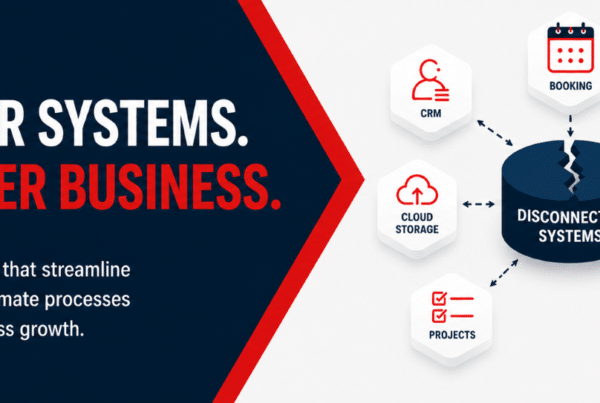
A business that relies on half a dozen disconnected systems simply to complete one customer journey.
Instead of information flowing naturally through the business, your team spends valuable time moving it between platforms.
The irony is that software designed to improve efficiency can eventually become one of the biggest obstacles to it.
It usually happens gradually;
⇒ A CRM is introduced to manage enquiries.
⇒ An online booking platform improves scheduling.
⇒ Accounting software handles invoicing.
⇒ Email marketing is added to nurture customers.
⇒ A cloud storage platform keeps documents organised.
⇒ Project management software helps coordinate work.
Too Much of a Good Thing: The Downside of App Clutter
Most software purchases begin by solving a genuine problem.
“We need somewhere to store customer details.”
“We need online bookings.”
“We need electronic job cards.”
“We need reporting.”
Each decision is logical. The problem isn’t buying software, rather buying software independently.
Before long your business might be using multiple software applications produced by global software companies across different departments.
“Most businesses don’t have a software problem. They have a workflow problem. Software simply exposes it.”

The Hidden Cost Isn’t Your Subscription Fees
Businesses often focus on software subscription costs.
-
- $29 per month.
- $89 per month.
- $199 per month.
It’s easy to dismiss individual subscription fees as negligible. But that is just the tip of the iceberg. The true financial drain remains hidden.
Every disconnected system creates invisible operational bottlenecks that compound over time, quietly eclipsing the cost of the software itself.
These are difficult to monitor and record as a cost :
⇒ Staff entering the same information multiple times.
⇒ Time spent searching for customer information.
⇒ Manual reporting.
⇒ Missed follow-ups.
⇒ Training staff across multiple platforms.
⇒ Integration failures.
⇒ Different versions of the same customer record.
⇒ Delays between departments.
“The biggest expense isn’t software. It’s duplicated effort.”

When Software Becomes “Owned” by One Person
As businesses grow, software is often introduced to solve an immediate problem within a single department. Over time, one employee naturally becomes the champion of that system, responsible for configuring it, maintaining it and helping others use it.
While this works initially, it can unintentionally create another business risk. The system becomes dependent on one person’s knowledge rather than documented business processes.
As more systems are introduced, this dependency can be repeated across multiple departments, leaving the business with fragmented knowledge, duplicated software and increasing operational risk.
A well-designed custom business platform shifts the focus away from individuals managing separate applications and towards a unified system built around the way the entire business operates.
Common challenges;
⇒ The software is used effectively within one department, but opportunities to improve workflows across the wider business are never realised.
⇒ Other team members rely on a single individual for support, training and troubleshooting.
⇒ When that employee leaves, valuable operational knowledge often leaves with them, making handovers difficult and increasing business disruption.
⇒ Software can gradually become neglected, with upgrades delayed, security patches missed and licences continuing to be paid for applications that are no longer actively used.
“The greatest risk isn’t relying on software. It’s relying on one person to hold that software together.”
Most Businesses Don’t Have a Software Problem
They Have a Workflow Problem.
One of the biggest misconceptions we encounter is the belief that another software application will solve an operational problem.
In reality, adding another platform often acts as a temporary fix rather than addressing the underlying issue. It may solve one challenge within a department while unintentionally creating new complexities elsewhere in the business.
The best technology doesn’t force your business to adapt to it. It should support and enhance the way your business already operates.
Before choosing software, it’s important to understand the workflow first.
Every business is different.
⇒ Unique quoting methods
⇒ Different customer journeys
⇒ Distinct approval processes
⇒ Industry-specific operational requirements
⇒ Individual roles and responsibilitiesWhen software forces your team to change the way they work, efficiency suffers.
Staff begin creating workarounds, duplicating information between systems or relying on manual processes to bridge the gaps. Over time, these small compromises accumulate, reducing productivity and making the business more difficult to manage.
“A highly effective business platform is built from the workflow outward. It aligns technology with your natural operations, rather than the other way around. Instead of treating departments as isolated silos, it connects them into a cohesive, centralized ecosystem.”

Where Off-the-Shelf Software Begins to Struggle
There is absolutely a place for commercial software. In many singular cases it may offer the right solution.
However, growing businesses commonly experience:
⇒ Feature Bloat
Large enterprise systems often contain hundreds of features that smaller businesses never use.
⇒ Disconnected Data
Customer information exists in multiple systems.
⇒ Limited Integrations
Software connects, but only partially.
⇒ Manual Administration
Staff become the integration between platforms.
⇒ Vendor Lock-In
Pricing changes.
Features disappear.
APIs change.
Businesses are forced to adapt.
Why We Take a Different Approach
One of the advantages we bring isn’t simply software development.
It’s perspective.
Over the years we’ve implemented, integrated and supported countless third-party business systems including:
⇒ CRMs
⇒ Booking platforms
⇒ Accounting software
⇒ Email marketing systems
⇒ Customer portals
⇒ Industry-specific management platformsThat experience has shown us two important things;
First, many of these platforms are excellent at solving individual problems.
Second, they often struggle to solve the complete business workflow.
That’s why we don’t begin by recommending software. We begin by understanding how your business operates.

Is Your Business Ready for a Connected Business Platform?
Every business has at least one process that feels more manual than it should. It might be preparing quotes, scheduling jobs, following up enquiries, communicating with customers or simply moving information between multiple systems.
The question isn’t whether your business can be improved, it’s identifying where the biggest opportunity lies.
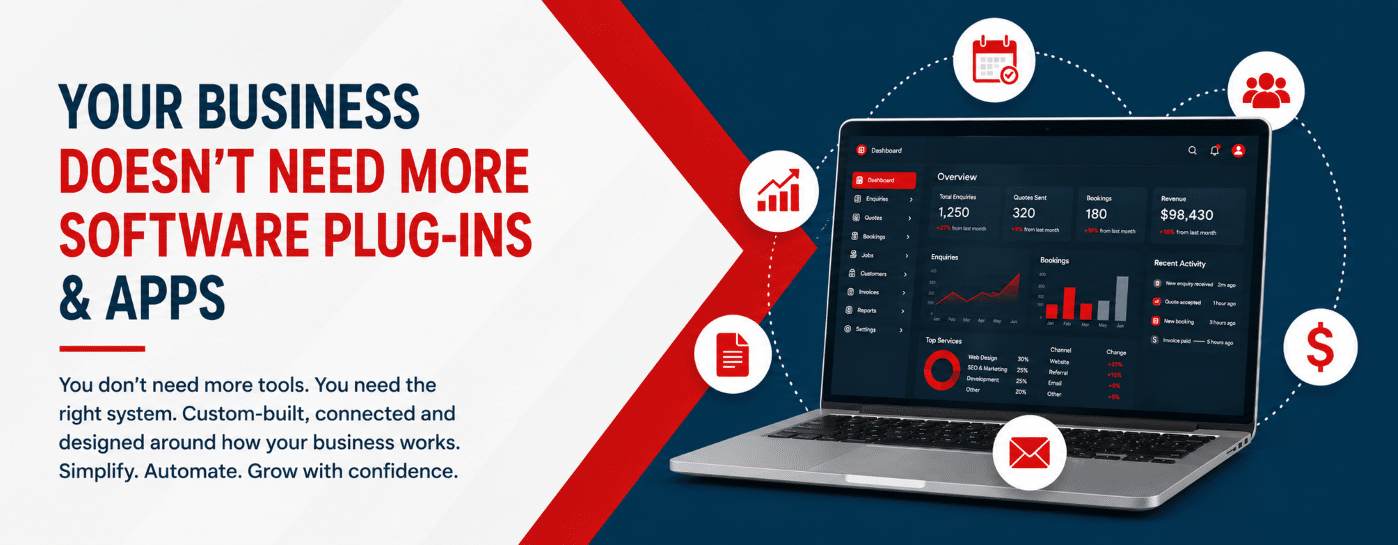
Sometimes that’s better integration or workflow optimisation. And sometimes it’s time to replace disconnected software with a single, connected business platform built around the way your business operates.
Let’s Start with a Conversation
Whether you’re exploring ideas or already know your current systems are holding you back, we’ll help you identify the most practical path forward.
We’ll review:
⇒ Your current business systems and workflows
⇒ Where time is being lost through manual processes
⇒ Opportunities to simplify, automate or integrate
⇒ Whether a connected custom business platform is the right fit for your business
What’s Your Biggest Business Bottleneck?
Not quite ready for a strategy session?
Our 2-Minute Business Process Survey is a simple way to identify the processes causing the most frustration within your business.
Complete Survey
Your responses help us understand where businesses are losing time and reveal opportunities to simplify operations through better workflows, automation and connected business systems.