Why Investing in Custom Business Software Could Cost Less Than You Think.
Investing in custom business software is often viewed as a significant investment in time and expense.
But what if the biggest cost is not building a better business system, but continuing to operate with a disconnected system that essentially ‘works’, but no longer supports the way you work?
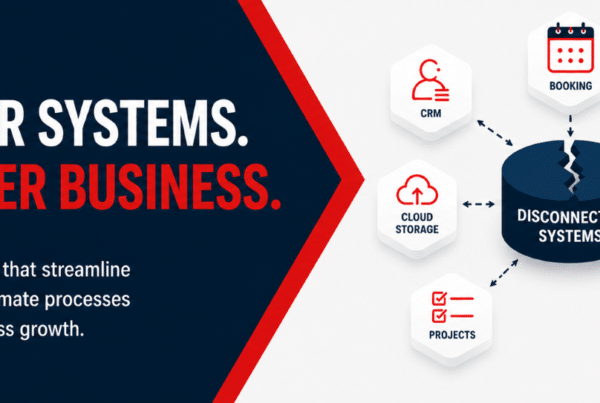
Disconnected software, duplicated data, manual workarounds and inefficient workflows quietly consume valuable employee time, reduce productivity and limit your ability to grow.
As new applications are introduced to solve individual problems, administration increases, processes become fragmented and your team spends more time managing software than serving customers.
These costs don’t arrive as a single invoice. They accumulate gradually, becoming a hidden operational tax on your business that can far exceed the investment required to build a connected platform designed specifically around the way your business operates.
The investment is simply not in the software.
It is in better systems, happier teams, improved efficiency and a business that’s built to scale.
The question is not:
“Can we afford to invest in custom software?”
It is:
“What is it costing our business not to invest?”
Your Business Already Holds the Blueprint
One of the biggest misconceptions surrounding custom software is that software developers invent better ways to run ‘all’ businesses. In reality, the businesses themselves already possess that knowledge.
Every successful business has developed its own intellectual property over years of experience, with explicit understanding of;
⇒ Your customers.
⇒ Your industry.
⇒ Your compliance requirements.
⇒ Your competitive advantages.
⇒ Your internal workflows.
⇒ The challenges your team solves every day.No off-the-shelf software provider understands the unique framework of your business because their products are built to serve thousands of generic needs rather than your specific operations. Ultimately, no provider understands the DNA of your business the way you do.
Custom business software is different.
Instead of forcing your business to adapt to generic software, it captures the processes, knowledge and experience that already make your business successful.
Technology becomes an extension of your business, and NOT the other way around.

Off-the-Shelf Software Has Specific Limits
Off-the-shelf software is built for the generic workflows of mass market, and not the exact operational needs of any one business. Vendors design products to serve thousands of organizations across multiple industries.
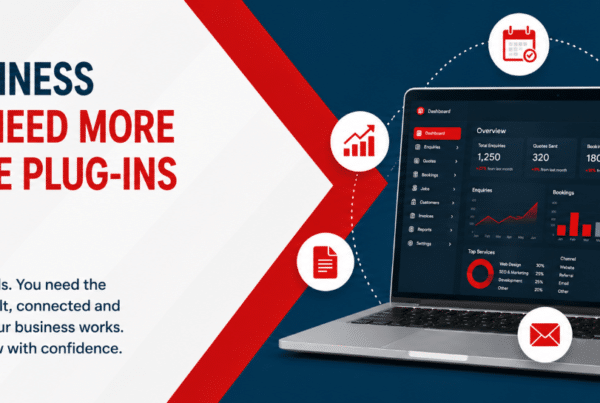
To keep their software globally scalable, compromises are inevitable. Consequently, vendors strictly limit bespoke modifications or plug-in customization to protect native support or to avoid breaking their progressive upgrade structures.
When businesses use off-the-shelf platforms, even premium tiers, they face constant operational friction. Instead of leveraging technology that mirrors their unique processes, companies are forced to warp their natural workflows to fit the rigid design of the software.
The limitations of a rigid system eventually manifest as critical operational inefficiencies. When off-the-shelf software is no longer viable, organizations face process duplication and constant workarounds as teams struggle to force-fit their daily routines into standardized workflows. Rather than streamlining operations, the technology introduces increasing complexity through a fragile overload of plugins alongside expensive, unused features. Compounded by a lack of tailored support, these inefficiencies inevitably stall scalability and drive severe team frustration across departments.
Custom business software removes those compromises, because it starts with your business and not a generic or ‘typical’ business model.
Custom Software Is A Business Asset.
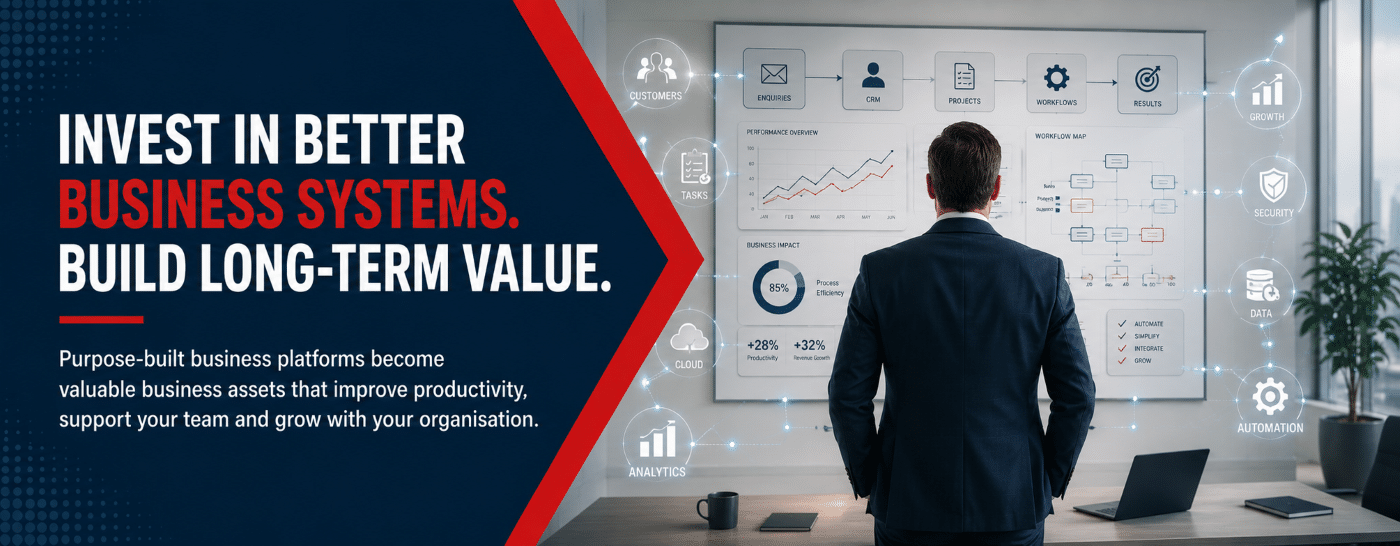
Every successful business invests in assets that improve efficiency, increase capacity and create long-term value. These investments aren’t simply expenses. They become assets that contribute to the overall value of the business.
⇒ Vehicles.
⇒ Plant and equipment.
⇒ Machinery.
⇒ Office fit-outs.
⇒ Commercial property.Purpose-built business software should be viewed in much the same way. Unlike subscription software, where every monthly payment is simply another operating expense, custom software creates an asset your business owns and controls.
Unlike a monthly software subscription, your investment is building something your business owns. An asset that can continue delivering value long after the development project has finished.
For some businesses, that asset may even become a competitive advantage capable of supporting expansion into new locations, licensing opportunities or entirely new revenue streams. Software developed specifically for your industry or operational model can become far more than an internal tool. It can become part of the value of the business itself.
The goal isn’t simply to buy software. It’s to build a business asset.

Could Your Project Be Eligible for R&D?
Every custom software project is different.
Like other capital investments, custom software is generally treated differently from day-to-day operating expenses for tax purposes. The costs associated with designing, developing and implementing a custom software platform are typically recognised as a capital asset rather than an immediate business expense.
Depending on your circumstances and current tax legislation, these costs may be depreciated over time or potentially qualify for other concessions. Businesses should always seek advice from their accountant regarding their specific situation.
Examples that may involve eligible R&D activities include:
⇒ Solving complex technical problems.
⇒ Developing genuinely new software capabilities.
⇒ Experimenting with AI-assisted workflows.
⇒ Creating innovative integration methodologies.
⇒ Developing scalable architectures where solutions are not already known.
Routine website development, installing commercial software or configuring existing platforms generally won’t qualify on their own.
The most valuable assets in a modern business aren’t always physical. They’re the systems, processes and knowledge that make the business operate.
Start Thinking About R&D Early
If your project may involve innovation, planning from the beginning is important. Maintaining records of technical challenges, experimentation and development decisions can become an important part of any future R&D claim. Official guidance emphasises contemporaneous documentation throughout the development process.
We work alongside experienced R&D specialists who assess eligibility and manage the claim process while we focus on designing and delivering innovative business systems.
Let’s Start with a Conversation
Whether you’re exploring ideas or already know your current systems are holding you back, we’ll help you identify the most practical path forward.
We’ll review:
⇒ Your current business systems and workflows
⇒ Where time is being lost through manual processes
⇒ Opportunities to simplify, automate or integrate
⇒ Whether a connected custom business platform is the right fit for your business

Invest in Your People, Not Just Your Technology
Systemising Institutional Knowledge
One of the greatest advantages of owning your business platform is that it changes the way knowledge is managed.
Instead of relying on one employee to maintain a CRM, another to manage reporting and someone else to understand integrations, your software becomes part of your operational framework. Knowledge becomes embedded within documented workflows rather than tied to individuals. This significantly reduces key-person risk, the invisible vulnerability created when critical operational knowledge exists only within one or two employees.
It also changes the role and KPI’s of your team. Rather than spending time moving information between disconnected applications, staff can focus on improving, managing and evolving the platform that supports the entire business.
As custom business systems mature, many organisations choose to develop internal capability by training staff to administer, optimise and continuously improve their business platform. That investment doesn’t simply strengthen the software, it strengthens the business.
Training Remains an Investment
While custom software itself is generally treated as a capital asset for tax purposes, staff training is typically treated differently.
Training employees to use a new business platform is generally considered an operating expense because it helps staff perform their existing roles more effectively. Training costs are generally deductible in the year they are incurred, subject to your accountant’s advice and your business circumstances.
From a business perspective, this distinction makes sense;
⇒ The software becomes an asset.
⇒ Your people become more capable.
⇒ Together, they create a business that is easier to manage, easier to scale and less dependent on any one individual.
Building a custom business platform is only part of the investment. The other investment is your people.

What’s Your Biggest Business Bottleneck?
Not quite ready for a strategy session?
Our 2-Minute Business Process Survey is a simple way to identify the processes causing the most frustration within your business.
Complete Survey
Your responses help us understand where businesses are losing time and reveal opportunities to simplify operations through better workflows, automation and connected business systems.